
A significant new study published in The Lancet Oncology has highlighted a concerning trend regarding breast cancer in India, revealing that the incidence of the disease has more than doubled over the past three decades. This global report provides a comprehensive look at the shifting landscape of oncology, particularly in developing nations.
Key Findings from the Global Study
The study, conducted by the Lancet Commission on Breast Cancer, provides a detailed analysis of data from 1990 to 2023, with projections extending to 2050.
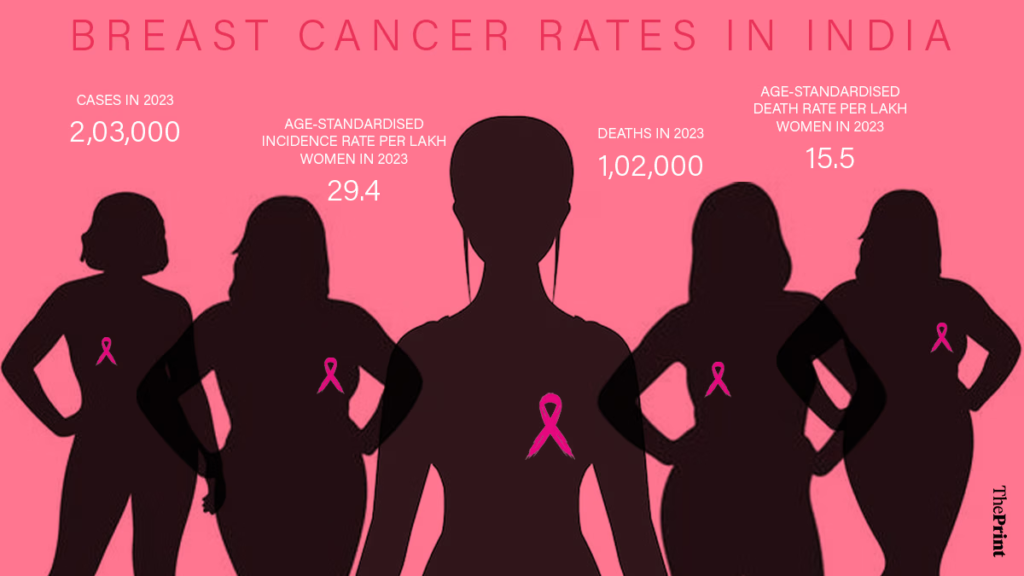
- Incidence Rates in India: The age-standardized incidence rate (ASIR) in India has surged from $13.0 per \100,000 women in 1990 to \29.4 per \100,000$ in 2023.
- Total Case Volume: In 2023 alone, India reported approximately $203,000 (2.03 lakh) new cases. This represents a staggering \477.8%$ increase in the total number of cases since 1990, driven by both rising incidence rates and population growth.
- Mortality Trends: While treatments have improved, the sheer volume of cases has led to a rise in deaths. In 2023, India saw approximately $98,300 deaths due to breast cancer, compared to \28,000$ in 1990.
- Impact on Younger Women: A notable finding in the Indian context is that breast cancer is increasingly being diagnosed in younger women compared to Western populations, often presenting at more advanced stages.
Comparative Statistics (1990 vs. 2023)
| Metric | 1990 Figure | 2023 Figure | Change |
|---|---|---|---|
| New Annual Cases | ~35,000 | ~203,000 | +477.8% |
| Annual Deaths | ~28,000 | ~98,300 | +251% |
| Incidence Rate (ASIR) | $13.0 per \100,000$ | $29.4 per \100,000$ | > 2x Increase |
Global Context and Future Projections
The report emphasizes that this is not just an Indian phenomenon, but a global one, though the burden is shifting heavily toward low- and middle-income countries.
- Global Totals: In 2023, there were an estimated $2.3 million new breast cancer cases and \764,000$ deaths worldwide.
- The 2050 Outlook: Projections suggest that global cases will rise to $3.5 million per year by 2050. Deaths are also predicted to climb, potentially reaching \1$ million annually by the mid-century mark.
- Economic Impact: The study estimates that by 2030, the global cost of breast cancer (including healthcare costs and lost productivity) will reach USD $329$ billion annually.
Factors Driving the Increase
Researchers attribute the sharp rise in India to several socio-economic and lifestyle shifts:
- Urbanization: Rapid movement to cities has changed dietary patterns and physical activity levels.
- Reproductive Changes: Factors such as later age at first childbirth, fewer children, and shorter breastfeeding durations are known contributors to higher breast cancer risk.
- Increased Awareness/Screening: Some of the “increase” is due to better detection and more women coming forward for screening, though many cases in India are still detected at Stage III or IV.
- Environmental Factors: Increased exposure to pollution and endocrine-disrupting chemicals in urban environments.
Recommendations from the Commission
The Lancet Commission has called for urgent policy changes to mitigate this crisis:
- Early Detection Programs: Improving “patient navigation” to ensure that once a lump is found, a woman can receive a diagnosis and start treatment within 60 days.
- Improved Data Collection: Enhancing cancer registries in India to better track and respond to regional hotspots.
- Addressing Inequities: Bridging the gap between urban and rural access to oncology specialists and radiotherapy.
Summary of Key Points The study serves as a “wake-up call,” showing that breast cancer is no longer just a disease of the West. In India, the doubling of the incidence rate since 1990 combined with a high mortality rate underscores the need for localized screening strategies and a more robust healthcare infrastructure to handle the projected $3.5$ million global cases by 2050.