
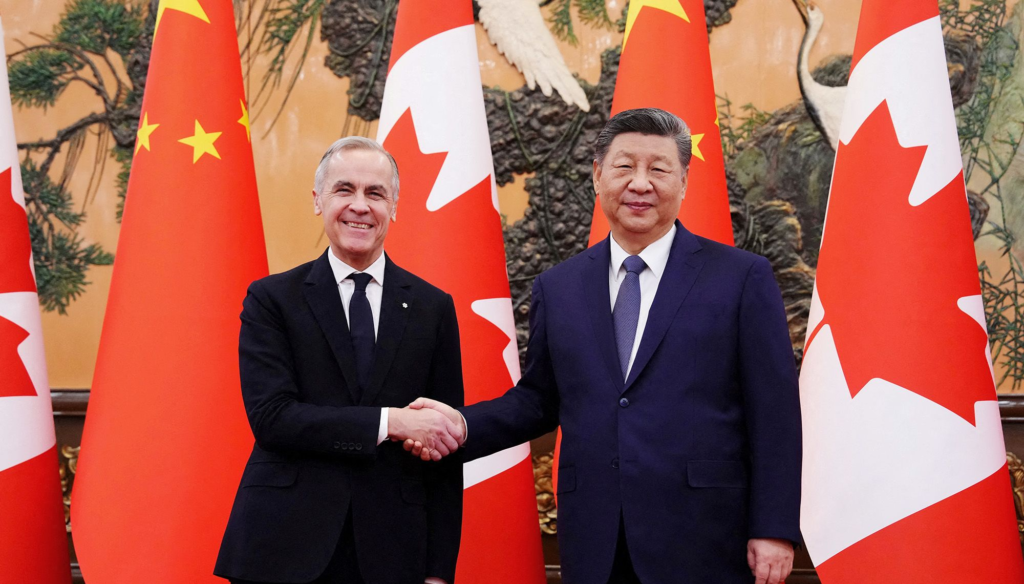
Canada’s Prime Minister has publicly welcomed a renewed strategic partnership with China, describing it as a necessary response to “new global realities” shaping the world economy and international relations. The statement came during high-level diplomatic talks between Canadian and Chinese leadership, marking a significant shift in the tone and direction of Canada–China relations after years of tension.
A Reset After Years of Strained Relations
For much of the past decade, relations between Canada and China had been difficult, affected by diplomatic disputes, trade restrictions, and broader geopolitical rivalries. High-level dialogue was limited, and economic cooperation slowed in several key sectors, particularly agriculture and technology.
The latest engagement signals a deliberate reset, with both governments emphasizing pragmatism over confrontation. Canadian officials have framed the renewed partnership not as an ideological alignment, but as a strategic and economic necessity in a rapidly changing global environment.
What “New Global Realities” Means
When the Canadian Prime Minister referred to “new global realities,” he was pointing to several major shifts affecting global policy decisions:
- A more fragmented global economy, marked by trade disruptions and protectionist policies
- Growing uncertainty in traditional alliances and supply chains
- The rise of a multipolar world, where economic power is no longer concentrated in a few countries
- Increased pressure on middle-power economies like Canada to diversify trade and investment partners
In this context, strengthening ties with China—one of the world’s largest economies—has been presented as a practical step to protect Canada’s long-term economic interests.
Key Areas of Cooperation
The strategic partnership focuses on economic engagement rather than political alignment, with attention given to sectors where both countries see mutual benefit.
Trade and agriculture are central to the discussions, particularly improving access for Canadian exports such as canola, seafood, and other agri-food products. These industries have been heavily affected by past tariffs and trade barriers.
Energy and clean technology cooperation also featured prominently. Canada has positioned itself as a reliable partner in the global energy transition, while China remains a dominant player in clean-tech manufacturing and investment. Both sides highlighted opportunities in renewable energy, battery technology, and climate-related initiatives.
Financial cooperation, tourism, education, and people-to-people exchanges were also mentioned as areas where ties could gradually be rebuilt.
Balancing Economic Opportunity and Caution
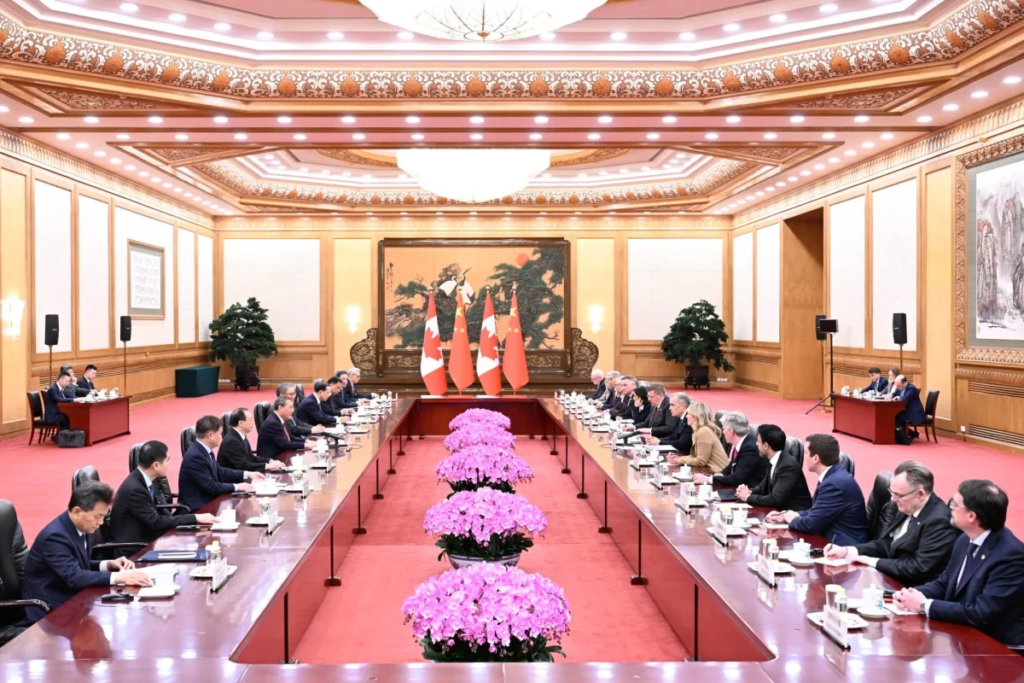
Canadian leaders have been careful to stress that renewed engagement with China does not mean ignoring concerns around security, human rights, or national interests. The government has emphasized that cooperation will be selective, rules-based, and aligned with Canada’s domestic priorities.
At the same time, officials acknowledge that complete disengagement from China is neither realistic nor beneficial, given the scale of China’s role in global trade.
Broader Global Implications
The announcement has attracted international attention because it reflects a broader trend among middle-sized economies seeking greater strategic autonomy. As global power dynamics evolve and traditional partnerships face strain, countries like Canada are reassessing how best to protect economic stability without becoming overly dependent on any single partner.
China, for its part, has welcomed the renewed dialogue as part of its effort to strengthen ties with developed economies amid global uncertainty.
Conclusion: The Canadian Prime Minister’s endorsement of a strategic partnership with China represents a calculated shift toward pragmatic diplomacy. Rather than a dramatic policy reversal, it reflects Canada’s attempt to adapt to changing global conditions by reopening dialogue, restoring economic cooperation, and diversifying international relationships.
As global realities continue to evolve, the success of this partnership will depend on how effectively both countries balance economic opportunity with political caution and long-term strategic interests.
#CanadaChinaRelations #GlobalPolitics #StrategicPartnership #WorldNews #InternationalRelations #Geopolitics #GlobalEconomy #ForeignPolicy #CanadaNews #Anslation #Carrerbook