

The future of work in the United States is undergoing a fundamental transformation driven by technological innovation, shifting workforce expectations, economic pressures, and public policy debates. Concepts once considered fringe—like four-day workweeks and Universal Basic Income (UBI)—are now part of mainstream discussions, particularly as automation and AI reshape labor markets.
1. Automation and AI: The Engine of Change
A New Technological Era
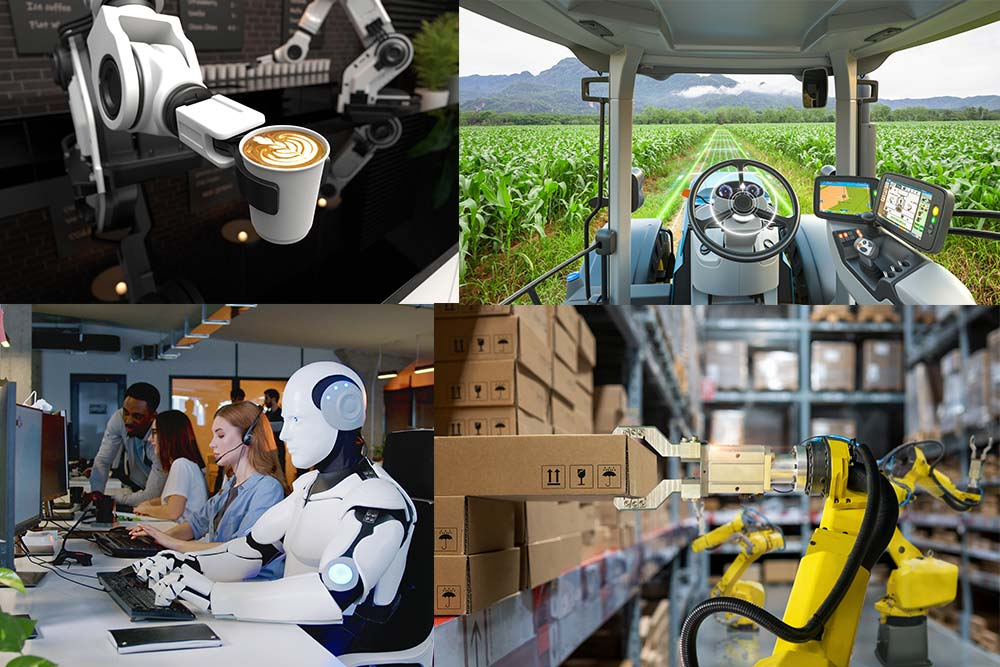
Artificial Intelligence (AI) and automation technologies are fundamentally changing how work is done. Rather than a sudden robot takeover, the shift involves gradual automation of routine tasks and augmentation of human work. McKinsey research suggests that while less than 5% of jobs are fully automatable, about 60% of job tasks could be automated to some degree.
This means:
- Routine and repetitive tasks will increasingly be handled by machines.
- Human work will focus more on socioemotional, creative, complex cognitive, and technical skills.
- New roles and industries will emerge around technology development, supervision, and maintenance.
Job Displacement vs. Job Creation
Leading figures and analysts highlight both the opportunities and risks:
- Geoffrey Hinton, known as the “Godfather of AI,” warns of mass unemployment if workforce adaptation lags behind technological gains.
- Politicians like Bernie Sanders have pointed to the possibility of tens of millions of U.S. jobs being affected by AI and automation.
The overall impact will likely vary by sector and skill level, with white-collar and routine tasks more susceptible to change compared to roles requiring complex human judgment.
2. Four-Day Workweek: Work Redefined
What It Is
A four-day workweek typically means a 32-hour workweek, often with maintained pay. Variations include compressed four-day schedules or reduced hours across five days.
Potential Benefits
Proponents argue the four-day week can:
- Enhance work-life balance and reduce burnout.
- Boost productivity by encouraging efficiency and prioritization of essential tasks.
- Improve employee well-being, reduce stress, and increase retention.
- Stimulate economic growth by increasing demand for leisure, tourism, and small business spending during time off.
Challenges and Criticisms
Despite the promise, there are significant hurdles:
- Not all industries can adopt reduced hours (e.g., healthcare, emergency services, manufacturing).
- Compressed hours may increase pressure, leading to stress if output expectations remain the same.
- Participatory inequality: White-collar workers may benefit disproportionately compared to service and frontline roles.
- There’s ongoing debate about whether productivity gains from AI will be shared with workers through reduced hours, or retained by companies as profit.
Real-World Adoption
Some organizations and local governments have piloted four-day workweeks with encouraging results, and private debates—such as those at major industry conferences on AI and work—are now common.
3. Universal Basic Income (UBI): Economic Safety Net or Social Reset?
Origins and Rationale
Universal Basic Income is a policy proposal where every adult receives a regular, unconditional cash payment from the government. It gained modern prominence in the U.S. through figures like Andrew Yang, whose 2020 campaign advocated for a monthly UBI to offset job loss from automation and ensure financial stability.
Why It’s on the Agenda
As automation advances:
- Job displacement and underemployment are growing concerns.
- Traditional safety nets (e.g., unemployment insurance, welfare programs) may not be enough.
- UBI is argued to provide an economic floor while reducing poverty and economic insecurity.
Debates and Concerns
Supporters say:
- UBI could decouple income from traditional employment.
- It may empower individuals to pursue education, caregiving, entrepreneurship, and creative endeavors.
Critics raise key issues:
- Cost and funding: Implementing UBI at a meaningful level requires substantial public expenditure.
- Labor incentives: Some worry unconditional income may reduce workforce participation.
- Equity and effectiveness: There’s debate about whether UBI alone addresses deeper structural inequalities.
Many analysts argue that if UBI is ever adopted, it would have to be part of a broader social contract that includes education, retraining, and healthcare reforms.
4. Broader Social and Policy Implications
Blended Work Models
Beyond hybrid work (in-office + remote), the future may see “blended work” where human and digital labor are inseparable—AI tools co-create, optimize, and augment daily work tasks. This requires new thinking about human agency, transparency, and accountability in AI-mediated environments.
Skills and Lifelong Learning
As automation handles routine work, skills like creativity, problem-solving, emotional intelligence, and technological fluency become increasingly valuable. Organizations and governments must invest in reskilling programs to prepare workers for these shifts.
Cultural and Psychological Shifts
Work is also a source of identity, social connection, and purpose. As hours decrease and automation increases, society will grapple with questions about:
- The value of leisure.
- How individuals find meaning outside traditional employment.
- The role of work in defining self-worth.
These discussions connect deeply with UBI and reduced-work paradigms.

Conclusion: The future of work in the United States is not predetermined. Instead, it is shaped by technology, policy choices, cultural values, and collective action. Key trends include:
- Automation and AI transforming the nature of work.
- Four-day workweeks gaining traction as a work-life balance strategy.
- UBI debates highlighting broader concerns about equity and economic security.
These issues intersect with broader social questions about fairness, purpose, and opportunity in a rapidly changing economy.
Future success will likely depend on combining innovation with inclusive policymaking, lifelong learning ecosystems, and economic safety nets that work for all citizens.
#UniversalBasicIncome #UBIDebate #EconomicSecurity #FutureEconomy #IncomeEquality #SocialPolicy #FutureOfWorkUSA #USWorkforce #AmericanEconomy #LaborMarket #WorkPolicy #EconomicTrends #Anslation #Carrerbook